Friday, January 18, 2013
Movies: Zero Dark Thirty
Zero Dark Thirty, in its simplest terms, is about the decade long pursuit and eventual assassination of Osama Bin Laden. It's written by journalist and screenwriter Mark Boal and directed by Kathryn Bigelow, partnered again after their successful collaboration on the excellent Academy Award winning 2010 feature The Hurt Locker, which dealt with bomb squads in Iraq. Between the two, Zero Dark Thirty is the superior film. While it may not actually be any more realistic in comparison, it certainly feels that way (that said, it is clearly a movie, not a documentary).
Jessica Chastain expertly plays Maya, whose first, and we come to learn only, case in her CIA career is the manhunt for the Al-Queda leader. Perhaps having a female protagonist helped Bigelow more effectively connect with the material. As acted and directed, Maya is a compelling character. Some complain that she's perhaps too cerebral, and somewhat emotionally distant, but I found it believable under the circumstances of her job and of "the war". Even so, she's plenty emotional. The final scene, a simple long, mostly silent closeup of her face, is ample evidence.
There are those who feel that the film is controversial in that, for them, it promotes the use of torture as a valuable tool to extract information. Instead, I found that the torture was presented straightforwardly as a matter of fact, leaving the audience to draw and discuss their own conclusions as to its usefulness and morality (personally, I can't imagine an audience member having a positive or perhaps jingoistic reaction to any of the torture scenes).
Both Maya and Maya's initial entry point into CIA interrogation procedures, Dan (a nicely understated perfomance by Jason Clarke) are ultimately affected by the grislier side of their work (Dan's is grislier, in that he is more "hands-on"). Perhaps it's the quality of universal workplace banality during the torture scenes, that sense in the room of "just another day at the office" for the interrogators, that some of the film's harsher critics see as an endorsement of certain interrogation tactics. I found it enhanced the horror of the entire situation.
The opening of the film starts with only white, Courier text on black, reading "September 11, 2001", then a sustained number of minutes with just that black screen and overlapping audio recordings of 9/11 emergency calls and news commentary. It's equally harrowing and effective.
The climax of the film comes when the military infiltration unit, colloquially called "The Canaries", make their attempt at breaching the Pakistan located compound where Osama Bin Laden finally met his end. The surprise of this group is Chris Pratt as squad member Justin. Where audiences are mostly familiar with him for his work as the goofy Andy on television's sitcom Parks and Recreation (and perhaps his fine dramatic turn in the feature baseball drama Moneyball), here he is a ripped, imposing soldier. His reaction to the outcome of a particular moment during the raid is intentionally almost washed away by the pressure of the time sensitive and potentially deadly nature of the raid, but he communicates it mostly with his eyes and voice, and it's stellar. A small moment, but stellar.
The film is an embarrassment of riches when it comes to supporting players. If you watch a lot of films you'll recognize a ton of exceptional character actors. Kyle Chandler (who also plays a CIA executive in Argo, coincidentally), Mark Duplass, Joel Edgerton, and Mark Strong are among them.
I think that the Academy Awards, having upped their Best Feature category to potentially 10 films, will have to do the same with the Directing category. This is Bigelow's best work to date, and it's a shame she's been overlooked (though I wouldn't necessarily bump someone else for her; it's an impressive list of directors as is, 2012 a good year).
Recommended.
Saturday, January 12, 2013
Movies: The Hobbit: An Unexpected Journey
Back on Boxing Day in 2012, I saw The Hobbit: An Unexpected Journey at the Scotiabank Theatre in Toronto, in a cinema that was showing it at 48 frames-per-second or "fps" (which has been dubbed "HFR" for "High Frame Rate" by the dubious Hollywood marketing wags), in stereoscopic 3D (which I'll dub "S3D", so I don't go mad from typing). The glasses were passive, meaning that they are the recycled polarized version, rather than the large, powered, alternating, active shutter glasses that some stereoscopic presentations are afforded. I was almost exact centre seat-wise, and two rows closer to screen row-wise, so it was almost ideal seating (two rows back and my resting eyeline would've been exactly centre to the screen).
I must say that my viewing of the film was mostly for research purposes, as I work in the animation and visual effects industry. I'm not a huge fan of the Lord of the Rings films. In fact by the last one I was mostly done with them, though I do have them on DVD, again mainly as work reference. I've never read any J.R.R. Tolkien works, and have no desire to do so. My main previous experience with Tolkien was though the Rankin/Bass animated musical versions I saw on TV as a child. Other than the Lloyd Alexander books I read in my pre-teen years, straight up fantasy fiction with wizards and the like has never really been my bag.
The first strange thing I noticed was that when the "Wingnut" title card came up, it was severely aliased, which was very noticeable as white text on a black background. Then the main Hobbit title came up, and the image was fine with no aliasing, banding, or noise of any kind, and I wouldn't see that problem again until the the very end, with the film's white-on-black closing credits.
I had heard complaints that the film looked like a videotaped stage play, so I was braced for that look. When the film's prologue began, what I was not prepared for was the experience of the majority of the footage looking as though it was fast-fowarded, as though someone was zinging through old VHS tapes on a VCR. That the prologue was mostly manically choreographed and edited only exacerbated the issue. It was such an onslaught of visual ugliness that I seriously considered leaving the theatre for a refund. I stayed, but I continued to notice this phenomenon repeatedly throughout the film, mostly when either characters and objects in frame or the camera did any fast movements, whether subtle or broad. Natural things like running, fighting, or falling just looked strange at times.
I have yet to read a satisfactory explanation of the so-called "Benny Hill Effect".
Where the 48 fps frame rate really benefits the film is in its improvement of the S3D experience. Where stereoscopic films at 24 fps often suffer from a View-Master look, where the scale of subjects often looks miniaturized and the depth somewhat shallow, I found the scale, heft, and depth of subjects at 48 fps with S3D seemed closer to reality. In particular, wide, slow arcing shots of landscapes with characters moving through them had a deep, epic quality. S3D at 48fps was also much more comfortable on my eyes, as I could shift my focus around the frame without experiencing the usual eyestrain that occurs with S3D at 24fps.
In general with 48 fps, I found that scenes with subtler, dimmer lighting were preferable to those with more stylized, direct lighting. Scenes at Bag End mostly looked awful, and scenes at dwindling campfires or in caves looked quite nice, for example.
Most of the VFX work is of the highest calibre, but there are a few rushed effects here and there, the worst of which is the sequence when Radagast the Brown on his sleigh driven by rabbits is pursued by orcs on wargs, which visually is exceptionally phony. Many sub-par vfx shots are also in the terrible prologue, and there is an dwarf-orc war in multiple flashbacks that might have worked better if it weren't so visually stylized with haze and blooms.
Aside from all this talk about technique, as far as the actual content of the film goes...
Martin Freeman is charming as Bilbo Baggins, the title character, and his comic timing well serves the light nature of the original narrative. Unfortunately writer/director Peter Jackson works against this tone by trying to shoehorn in as many connections to his previous Rings trilogy as possible, with all the portentous bloviating that entails. A 200 page light-hearted adventure romp for kids shouldn't be turned into a three film, nine hour drag, methinks.
I wasn't bored, but it was overlong, and the only two characters that held any interest for me were Bilbo, and when he shows up, Gollum (again acted by Andy Serkis - and - a boatload of Weta character animators, despite anything you hear or read to the contrary). Their sequence together, which I think is known as the "Cave of Riddles", is likely the best of the film.
It was a bit of fun to see Bret McKenzie from Flight of the Conchords in a small speaking role.
In summary: the film content-wise is mediocre but not terrible, and technique-wise it's often off-putting, and will continue to be for subsequent films until they get the kinks sorted out (and there are a lot of kinks to sort thus far). It is the first of its kind, though, so I guess that's something.
Labels:
48 fps,
andy serkis,
bret mckenzie,
hfr,
martin freeman,
movies,
peter jackson,
stereoscopic 3d,
the hobbit
Wednesday, November 14, 2012
Movies: The House of the Devil, The Innkeepers, V/H/S, and World War Z (Trailer)
In October I watched a number of horror films, as I am a fan and I like to get into the spirit of Halloween. I meant to do a blog post. Almost one month later, here it is! I think the appropriate reaction is: "Slacker!"
The House of the Devil
Ti West is a thirty-something director who has a terrific sensibility for the horror genre. His The House of the Devil is both his love letter to late '70s, early '80s horror flicks (like those of John Carpenter), and a masterful slow-burn of a film, where "slow-burn" is defined as a deliberate, incremental build up of tension over time to an explosive conclusion. Some viewers don't like slow burn films, but when they're done as well as this film is, I can't get enough of them.
Samantha (nicely underplayed by Jocelin Donahue) is a young college student in the '80s. Mousy but pleasant, also a bit of a neat freak and sometimes a little high strung, she's found a room for rent so she can get away from her current dorm situation living with an inconsiderate slob of a roommate. The trouble is, she doesn't quite have the money to make the move, so she takes a babysitting job to make the deposit so she can move in the following week.
Soon enough, as is always the case in a horror movie, frightening, terrible things ensue.
Not only is the film set in the early '80s, but it is made to look as if it was filmed in the early '80s (it was released in 2009). The opening title sequence, set to a song that sounds like a darker, Carpenter rewritten instrumental version of The Cars "Moving In Stereo", is terrific, and spot-on period accurate.
Likeable characters behaving believably in situations spiralling out of their control: what more could you ask for in a horror movie?
Highly recommended.
- Spoiler Territory -
One of the sequences that I found most harrowing was when Samantha, alone in the large Victorian-style Ulman house, puts on her Walkman headphones and cranks The Fixx's "One Thing Leads To Another", while dancing around on the first floor to relieve boredom and overcome those unfounded alone-in-a-big-empty-house fears. Only we know that those fears are in this case actually reliable, and the situation is much worse than she could imagine (although even we don't know how much worse it is for her at this point in the film). On the soundtrack, the song is all you can hear, there's no ambient sound at all. I was squirming in my seat.
Anticipation, it's a killer.
The Innkeepers
While making The House of the Devil, Ti West stayed at an inn called The Yankee Pedlar. For The Innkeepers, West decided to film it there. It is, after all, a great location for a good old-fashioned ghost story.
Claire is an endearingly goofy slacker of a young woman (well acted by Sara Paxton) working at the Pedlar. She has a recurring asthmatic condition and a vivid imagination. Her supervisor is Luke (a terrific performance by Pat Healy), who is slightly too old for this kind of job, and is supplementing his meagre income by building and running a website about haunted locations and paranormal activities.
The Pedlar is in its final days of operation, with Claire and Luke operating as the skeleton crew. The Pedlar has some paranormal history of its own, supposedly, so to while away the hours in the mostly empty inn, Claire and Luke use his audio and video equipment to try and capture some spooky activity for the website.
After a setup that would play as a sweet, gentle comedy were this a different sort of film, frightening, terrible things ensue.
While not quite as sleek or strong as The House of the Devil, it shares that film's focus on character, and I'm recommending it as well.
- Spoiler Territory -
I've read negative criticism of The Innkeepers as being too much of a slow burn with no real payoff, and I think the problem for some is this: the story is presented in a such a way that it could be taken as either supernatural, or not supernatural at all. In fact, I think there's enough evidence in the movie to argue that all of the supernatural stuff is Claire's vivid imagination run wild, and none of it is actually happening. Even so, I have no problem with the story even if that's the case.
V/H/S
I had read about V/H/S prior to it's release, and was interested in it, as it was to be a collection of short stories made by directors and writers who were being touted in some circles as "the next great generation of horror filmmakers", including Ti West (who as you might have noticed I already thought was two for two in the recommended column).
The premise is this: a group of miscreants (who assault women in public and destroy property, make videos while doing so, and then upload those videos to the internet as a way of making money) are given a job to break into a house to steal a collection of videotapes. They find a corpse at the house, seated in front of a television, with a VCR and a number of VHS tapes. They watch five of the tapes, each labelled with only a date, and each of those tapes constitutes one of the stories. The sixth story is this framing premise.
There are two major problems this film has to overcome:
First, it's an anthology, and the stop-start nature of anthologies is tough to overcome. Truth is, I'm not sure I've seen a really good anthology movie, well...ever.
Second, it's a found footage film. There are slightly more good found-footage films than there are anthology films, which is to say slightly more than none. I wrote a post about them.
Suffice to say that I found V/H/S to be a disappointment for the most part (unfortunately including West's segment called Second Honeymoon), save for one story element that really works. The first story is called Amateur Night, where three college age jerks go out barhopping to pick up drunk girls. The nerdiest of the jerks is given a pair of glasses that have a video camera hidden in them (found footage!), and the story is played out from his viewpoint.
While at one bar, they get very drunk and meet a bunch of drunk girls. They also meet Lily. That's her in the picture above (played in the film's best performance by Hannah Fierman, whose eyes are disconcertingly large for her face and used to full advantage). You see her on the fringes initially, in the background, always staring unblinking at the camera. Eventually she approaches and says the only thing she ever says when she speaks: "I like you".
A bunch of them go back to the jerks hotel room, Lily in tow. Frightening. Terrible. Things. Ensue.
Considering the majority of the characters in all of the segments are too thinly drawn, or unrepentent assholes, or both, I can't recommend seeing V/H/S (and therefore, no spoilers necessary).
World War Z (Trailer)
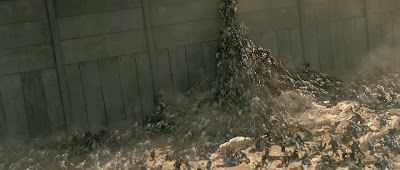
The book World War Z by Max Brooks is a terrific read. It concerns the aftermath of the zombie apocalypse, as told by a U.N. representative in a tell-all report chronicling the spread of the outbreak and key events in the resulting war and its eventual outcome. The report consists of interviews with individuals from across the world, each telling their story of survival. China, the U.S., Japan, Canada, and India are some of the key locales. Go get a copy and read it right now.
So I see this trailer for the movie World War Z and...
Say you have a movie trailer. The trailer shows you all of these mouth-watering shots of pizza, some truly delicious looking pizza. Then the title for the movie comes up and it's called "Spaghetti". "Wait", you say. "I know spaghetti, I enjoy spaghetti, and that sure isn't spaghetti. Why did they call it spaghetti?" Then some folks on the Interwebs say "that looks delicious, who cares if it's called Spaghetti, spaghetti isn't all that anyway, they're both Italian foods so what does it matter, quit your complaining".
So there's my strange analogy about my opinion of the trailer. Looks cool, but I sure don't see the book in there.
Read the book.
Did I mention you should read the book?
The House of the Devil
Ti West is a thirty-something director who has a terrific sensibility for the horror genre. His The House of the Devil is both his love letter to late '70s, early '80s horror flicks (like those of John Carpenter), and a masterful slow-burn of a film, where "slow-burn" is defined as a deliberate, incremental build up of tension over time to an explosive conclusion. Some viewers don't like slow burn films, but when they're done as well as this film is, I can't get enough of them.
Samantha (nicely underplayed by Jocelin Donahue) is a young college student in the '80s. Mousy but pleasant, also a bit of a neat freak and sometimes a little high strung, she's found a room for rent so she can get away from her current dorm situation living with an inconsiderate slob of a roommate. The trouble is, she doesn't quite have the money to make the move, so she takes a babysitting job to make the deposit so she can move in the following week.
Soon enough, as is always the case in a horror movie, frightening, terrible things ensue.
Not only is the film set in the early '80s, but it is made to look as if it was filmed in the early '80s (it was released in 2009). The opening title sequence, set to a song that sounds like a darker, Carpenter rewritten instrumental version of The Cars "Moving In Stereo", is terrific, and spot-on period accurate.
Likeable characters behaving believably in situations spiralling out of their control: what more could you ask for in a horror movie?
Highly recommended.
- Spoiler Territory -
One of the sequences that I found most harrowing was when Samantha, alone in the large Victorian-style Ulman house, puts on her Walkman headphones and cranks The Fixx's "One Thing Leads To Another", while dancing around on the first floor to relieve boredom and overcome those unfounded alone-in-a-big-empty-house fears. Only we know that those fears are in this case actually reliable, and the situation is much worse than she could imagine (although even we don't know how much worse it is for her at this point in the film). On the soundtrack, the song is all you can hear, there's no ambient sound at all. I was squirming in my seat.
Anticipation, it's a killer.
The Innkeepers
While making The House of the Devil, Ti West stayed at an inn called The Yankee Pedlar. For The Innkeepers, West decided to film it there. It is, after all, a great location for a good old-fashioned ghost story.
Claire is an endearingly goofy slacker of a young woman (well acted by Sara Paxton) working at the Pedlar. She has a recurring asthmatic condition and a vivid imagination. Her supervisor is Luke (a terrific performance by Pat Healy), who is slightly too old for this kind of job, and is supplementing his meagre income by building and running a website about haunted locations and paranormal activities.
The Pedlar is in its final days of operation, with Claire and Luke operating as the skeleton crew. The Pedlar has some paranormal history of its own, supposedly, so to while away the hours in the mostly empty inn, Claire and Luke use his audio and video equipment to try and capture some spooky activity for the website.
After a setup that would play as a sweet, gentle comedy were this a different sort of film, frightening, terrible things ensue.
While not quite as sleek or strong as The House of the Devil, it shares that film's focus on character, and I'm recommending it as well.
- Spoiler Territory -
I've read negative criticism of The Innkeepers as being too much of a slow burn with no real payoff, and I think the problem for some is this: the story is presented in a such a way that it could be taken as either supernatural, or not supernatural at all. In fact, I think there's enough evidence in the movie to argue that all of the supernatural stuff is Claire's vivid imagination run wild, and none of it is actually happening. Even so, I have no problem with the story even if that's the case.
V/H/S
I had read about V/H/S prior to it's release, and was interested in it, as it was to be a collection of short stories made by directors and writers who were being touted in some circles as "the next great generation of horror filmmakers", including Ti West (who as you might have noticed I already thought was two for two in the recommended column).
The premise is this: a group of miscreants (who assault women in public and destroy property, make videos while doing so, and then upload those videos to the internet as a way of making money) are given a job to break into a house to steal a collection of videotapes. They find a corpse at the house, seated in front of a television, with a VCR and a number of VHS tapes. They watch five of the tapes, each labelled with only a date, and each of those tapes constitutes one of the stories. The sixth story is this framing premise.
There are two major problems this film has to overcome:
First, it's an anthology, and the stop-start nature of anthologies is tough to overcome. Truth is, I'm not sure I've seen a really good anthology movie, well...ever.
Second, it's a found footage film. There are slightly more good found-footage films than there are anthology films, which is to say slightly more than none. I wrote a post about them.
Suffice to say that I found V/H/S to be a disappointment for the most part (unfortunately including West's segment called Second Honeymoon), save for one story element that really works. The first story is called Amateur Night, where three college age jerks go out barhopping to pick up drunk girls. The nerdiest of the jerks is given a pair of glasses that have a video camera hidden in them (found footage!), and the story is played out from his viewpoint.
While at one bar, they get very drunk and meet a bunch of drunk girls. They also meet Lily. That's her in the picture above (played in the film's best performance by Hannah Fierman, whose eyes are disconcertingly large for her face and used to full advantage). You see her on the fringes initially, in the background, always staring unblinking at the camera. Eventually she approaches and says the only thing she ever says when she speaks: "I like you".
A bunch of them go back to the jerks hotel room, Lily in tow. Frightening. Terrible. Things. Ensue.
Considering the majority of the characters in all of the segments are too thinly drawn, or unrepentent assholes, or both, I can't recommend seeing V/H/S (and therefore, no spoilers necessary).
World War Z (Trailer)
The book World War Z by Max Brooks is a terrific read. It concerns the aftermath of the zombie apocalypse, as told by a U.N. representative in a tell-all report chronicling the spread of the outbreak and key events in the resulting war and its eventual outcome. The report consists of interviews with individuals from across the world, each telling their story of survival. China, the U.S., Japan, Canada, and India are some of the key locales. Go get a copy and read it right now.
So I see this trailer for the movie World War Z and...
Say you have a movie trailer. The trailer shows you all of these mouth-watering shots of pizza, some truly delicious looking pizza. Then the title for the movie comes up and it's called "Spaghetti". "Wait", you say. "I know spaghetti, I enjoy spaghetti, and that sure isn't spaghetti. Why did they call it spaghetti?" Then some folks on the Interwebs say "that looks delicious, who cares if it's called Spaghetti, spaghetti isn't all that anyway, they're both Italian foods so what does it matter, quit your complaining".
So there's my strange analogy about my opinion of the trailer. Looks cool, but I sure don't see the book in there.
Read the book.
Did I mention you should read the book?
Subscribe to:
Posts (Atom)


